Loading Bay Guide: Wheel Guides, Dock Bumpers, Plates
Set up wheel guides, dock bumpers and trailer plates as one system to cut impact damage and downtime at your loading bay.
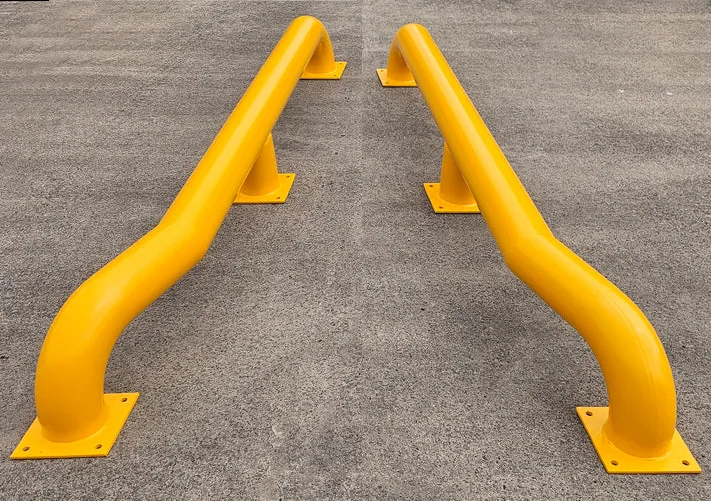
A well-planned loading bay protects people, the building and vehicles while keeping turnarounds quick. When wheel guides, trailer landing-leg plates and dock bumpers are treated not as separate parts but as one working system, impact damage and the downtime that follows drop noticeably. This guide takes a practical look at layout, fixings, ground conditions and alignment.
Think about layout before parts
Picture the bay as a sequence the driver follows: the vehicle approaches, passes between the wheel guides, stops against the bumpers, lowers its legs onto a plate, and unloading begins. Small alignment errors can undo even the best equipment choices, so measure carefully and position once.
- Vehicle envelope: Confirm the tallest and lowest trailer heights and the widest axle widths you receive.
- Approach angle: For vehicles arriving at a consistent angle from a one-way system, toe the guides in a few degrees to aid self-centring.
Positioning the wheel guides
Wheel guides prevent off-centre impacts and help drivers dock first time.
- Spacing: Leave a channel 200-250 mm wider than the widest tyre track on site for tolerance without snagging.
- Setback: Position the front ends 800-1200 mm ahead of the bumper face so drivers can stabilise before contact.
- Fixing: Use through-bolts sized to the base plates on sound concrete; on asphalt or weak sub-base, cast a concrete pad first.
Selecting trailer landing-leg plates
Landing legs can punch through asphalt and break slab edges, causing costly surface failures. A dedicated plate spreads the load and provides a consistent stop point.
- Material: UHMWPE (ultra-high-molecular-weight polyethylene) plates resist abrasion and stay smooth enough to ease leg placement.
- Fixing pattern: Use the full set of countersunk anchors on high-use bays; lighter loads on strong slabs may need only corner and centre fixings with engineer approval.
- Location: With the trailer against the bumpers, the legs should sit within the central third of the plate; mark the edges with reflective tape.
Getting dock bumpers right
Dock bumpers are a sacrificial layer that protects the building. The right combination of back plate, rubber pad and optional UHMWPE front reduces both building damage and how often pads need changing.
- Back plates: Choose galvanised plates for outdoor durability; plain steel suits sheltered internal docks.
- Rubber pads: Standard SBR pads absorb impact energy and replace quickly; renew them at the first sign of splits or compression set.
- UHMWPE fronts: Where there is high slide and frequent docking, a low-friction face extends rubber pad life.
Safety and routine inspection
For most trailers, set the bumper centreline around 450-500 mm above finished floor level. Use chocks during loading to prevent rollaway, keep walking routes free of cable trip hazards, and before busy periods check for loose fixings, surface rust and bent sections.